The Universality of World Models
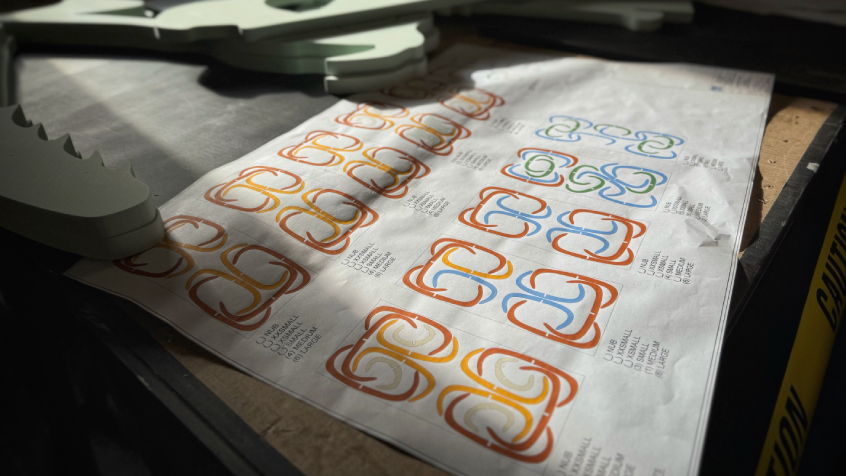
Google's recently released Genie 3 represents a breakthrough in world modeling but it's actually just one instance of something universal. Every creative and problem-solving domain involves navigating constraint spaces that function as physics. Whether you're writing fiction, debugging code, or composing music, you're doing the same fundamental work as Genie 3: exploring what's possible within a system of constraints. Photo Credit: Rob Grzywinski
Google recently released Genie 3, a world model that can generate interactive 3D environments in real-time from simple text prompts. Demis Hassabis, the CEO of Google DeepMind, talks about it as a breakthrough because it understands physics. But he's thinking too small. He's focused on robots and games when the real insight is staring him in the face:Every creative act is world-building. Every world is defined by constraints that function as physics.The water flowing from Genie's tap isn't more "real" than the social physics governing Gogol's nose-bureaucrat. They're both constraint systems that create explorable realities. One follows the laws we're used to; the other follows laws that are equally rigorous but utterly strange.The Nose Knows
There's a moment in Gogol's "The Nose" where a civil servant's nose detaches, puts on a uniform, and starts outranking him in government service. Your brain doesn't reject this as "impossible" — it accepts it as the "physics" of this particular world. You're inhabiting a constraint space where noses can become bureaucrats and somehow it all makes sense.That's not literary magic. That's world model navigation.The nose-world has rules: detached noses can become people but they must follow some logic about how nose-people behave in 19th-century St. Petersburg. The constraints are surreal but they're consistent. That consistency is what makes the world navigable, explorable, real.When you read that story, you're doing exactly what a robot does when it learns to walk in a simulated environment. You're testing the boundaries, discovering what's possible, adapting to the physics of the space you're inhabiting.Beyond the Physical
Look around. World models are everywhere, hiding in plain sight:Software development isn't just coding — it's navigating the constraint space defined by programming languages, APIs, business requirements, and user expectations. Every bug fix is an exploration of what's possible within those constraints. Every elegant solution emerges from understanding how the rules interact.Musical composition creates sonic worlds with their own gravitational forces. Harmonic progressions aren't just conventions — they're the physics that govern how tension and resolution work in musical space. Jazz musicians don't just improvise; they explore the constraint space of chord changes, finding new paths through familiar territory.Game design creates interactive constraint spaces where players discover what's possible. The most engaging games aren't those with the most realistic graphics — they're those with the most compelling physics, where the rules create emergent possibilities that surprise even their creators.The Squishy Problem
Today's Large Language Models are incredible pattern matchers, but they're fundamentally "squishy". They exist in a sea of probability without solid constraints to push against. They can mimic the outputs of any world model but they can't truly inhabit one because they have no way to specify which world they're supposed to be consistent with.Ask an LLM to continue Gogol's story and it might produce beautiful prose that sounds like Gogol. But it's not actually navigating the nose-world's constraints. It's pattern-matching against similar text it's seen before. It's the difference between understanding the physics and mimicking the behavior.This is why even our most sophisticated AI systems feel somehow hollow. They're impressive mimics, but they're not truly inhabiting the worlds they describe. They're floating in probability space instead of walking on solid constraint-ground.The Universal Interface
What makes Genie 3 special isn't that it models physics, it's that it makes constraint exploration interactive. You can navigate its worlds, test their boundaries, discover their possibilities. But here's the breakthrough waiting to happen: We need this same interactive exploration for every kind of world model.Genie 3 generates worlds with water physics and object persistence. But when are we going to "play" in the world model from Gogol's "The Nose"?When are we going to build tools that let us inhabit musical constraint spaces as directly as we navigate 3D physics? When will we have systems that make the logic of fictional worlds as explorable as any simulation? When will we have programming environments that let us navigate code not as text but as the constraint landscape it actually represents?The Pattern Behind the Pattern
What we're missing is the recognition that these are all the same fundamental thing.Whether you're:- Training a robot to navigate physical space
- Debugging a complex software system
- Composing a piece of music
- Writing a story that readers can inhabit
You're doing the same work: exploring what's possible within a system of constraints.The future isn't about better physics engines. It's about recognizing that writers, programmers, composers, and yes, robot trainers, are all doing the same fundamental work — exploring what's possible when constraints create rather than limit possibility.The World We're Building
Every time you solve a problem, you're not just finding an answer — you're discovering the shape of a constraint space. Every time you create something, you're not just making an artifact — you're building a world that others can inhabit.The breakthrough isn't Genie 3's ability to create interactive worlds with consistent physics. The breakthrough is recognizing that constraint spaces are the universal substrate of all exploration, all creativity, all understanding.We're not just building better world models. We're discovering that we've been world-builders all along.
 Modern ML has a "looks confident while being wrong" problem that control theorists solved decades ago. Diffusion models, flow matching, selective SSMs, and test-time compute are all secretly rediscovering the same primitive — the gain function — from different directions. None of them cite Yang/Mehta/Meyn 2013.1 May 2026
 The dirty secret of AI productivity: when you can think at machine speed, your human brain becomes the bottleneck. We've created intelligence abundance only to discover we have no idea how to handle it — and we desperately need new interfaces for thinking with AI rather than just at it.13 June 2025